For many export companies, independent sales agents are essential to accessing international markets. They bring local credibility, the necessary language skills, and valuable networks. Yet they often operate outside the company’s internal systems, such as CRM and ERP, and therefore lack the same access to up-to-date information as employees at headquarters.
When agents cannot access current data, the company gradually loses control over how its products are presented and priced across different markets.
Prices may be outdated. Product information may be inaccurate. Documentation may be incomplete.
Independent agents often represent several suppliers at the same time. Their time is limited, so they naturally prioritize the materials that are easiest to access and understand—for themselves and for the customers they serve.
As a result, old PDFs or price lists buried in their inboxes can easily become their preferred tools. Not because agents want to work with outdated materials, but because it can be difficult to know whether the version stored locally is actually the latest one.
How Do You Build a Customer Portal That People Actually Use?
Most export companies already understand what an agent, dealer, or customer portal can do. The challenge is rarely recognizing the need for a digital point of access.
The difficult part is creating a portal that becomes an integral part of the agent’s daily workflow.
The principle is simple: It must be easier for agents to find the correct materials in the portal than to search through old and new files on their own computers.
The portal should always allow agents to:
Find current pricing
View the latest product data sheets, including images and variant specifications
Access accurate documentation in the relevant language
Find answers without having to contact headquarters first
If the portal simply becomes another system agents must remember to log in to—while the same information is still easier to find elsewhere—there is a significant risk that it will never become their preferred tool.
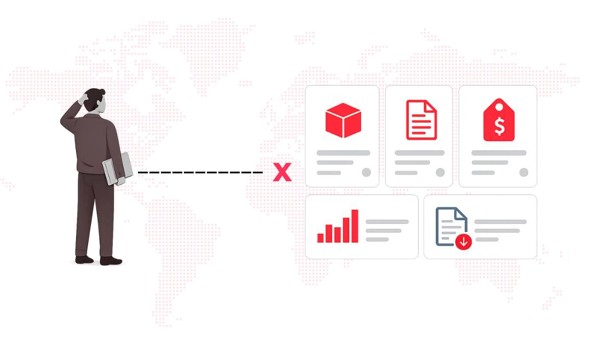
Why Do Portals Fail?
The problem is often not the technology itself. It is everything surrounding it.
A portal can be well designed and technically sound yet still deliver limited value if the product data is outdated, ownership of the content is unclear, or the organization continues to send documents and pricing directly by email.
This creates two parallel workflows: the official digital channel and the old manual process. Naturally, agents choose whichever is easier.
A successful portal therefore requires more than a technical implementation. Companies must also address questions such as:
Who owns and maintains the data agents see?
Which system is the authoritative source for pricing, product data, and documentation?
Who is responsible for publishing new content correctly?
How will agents be onboarded to the solution?
Which legacy workflows should be phased out when the portal goes live?
This is largely an organizational transformation—not just an IT project.
ROI Only Emerges When Behavior Changes
The business case for a portal should not be measured simply by whether the solution exists.
The real value emerges when agents can easily find the materials they need and trust that the information is accurate.
By bringing agents into a controlled digital environment, export companies gain more than accurate data. When core systems such as ERP and PIM are properly integrated, agents become more efficient, while the company gains greater control over how its products are presented.
The technology must also be supported by clear processes, defined responsibilities, and incentives to use the solution.
Only then does a customer portal deliver its full value. It becomes an integral part of the company’s growth engine and turns agents into stronger ambassadors for its products.
However, a portal is only as reliable as the data it displays.
In the next article, we will explore why PIM systems often play a central role in modern export companies—and how they create a single, authoritative source of product data across languages, markets, and sales channels.